Genetic testing companies have a problem their boards finally notice: patients don’t understand their results. Even at leading centers, a significant portion of patients leave with positive, negative, or variants of uncertain significance (VUS) results that they cannot interpret without hours of counselor time. This isn’t just a patient experience issue. It is a revenue leak, an NPS killer, and a compliance risk hiding in plain sight.
Here’s what separates the companies seeing results from the ones still piloting: who owns it in the organization.
We’ve built and deployed this capability at three genomics companies. Our Medical AI Assistant for Genomic Reports handles patient result questions with verified, traceable answers grounded in their specific reports. If you’re evaluating this for your organization, we can share what the deployment actually looks like.
Why Now: The Market Has Shifted
A Harvard-led study published in the journal Science found that OpenAI’s o1 reasoning model achieved 67% accuracy in emergency medicine diagnoses, compared to 50%–55% for human physicians in a trial involving 76 emergency department patients. The AI advantage was most pronounced in high-pressure scenarios with limited information. The results were covered widely and the full study is available in Science.
The researchers were careful to note that the study only used text-based patient records — the AI couldn’t see physical appearance or detect non-verbal distress cues that doctors rely on. Lead author Arjun Manrai of Harvard Medical School described it as “a profound change in technology that will reshape medicine,” while emphasizing that AI should join physicians in a new “triadic care model” rather than replace them.
The implications for genomics are direct. If reasoning models are already outperforming doctors in text-based clinical reasoning, the gap between what patients get from a static PDF report and what they could get from a conversational, report-grounded AI assistant is no longer theoretical. The question is governance, not capability.
Nearly one in five US physicians are already using AI to assist diagnosis. The UK’s Royal College of Physicians found 16% of doctors use the technology daily. The biggest concern they cited: AI error and liability. That is exactly why C-suite ownership matters — because these systems need governance frameworks that only board-level accountability can enforce.
Who This Is For
CEOs, CFOs, Chief Strategy Officers, and board members at genetic testing companies, hospital labs, and precision medicine startups who are evaluating AI initiatives but unsure how to structure them for success.
The Business Case: Three Value Pools
Revenue: From One-Off Tests to Lifelong Relationships
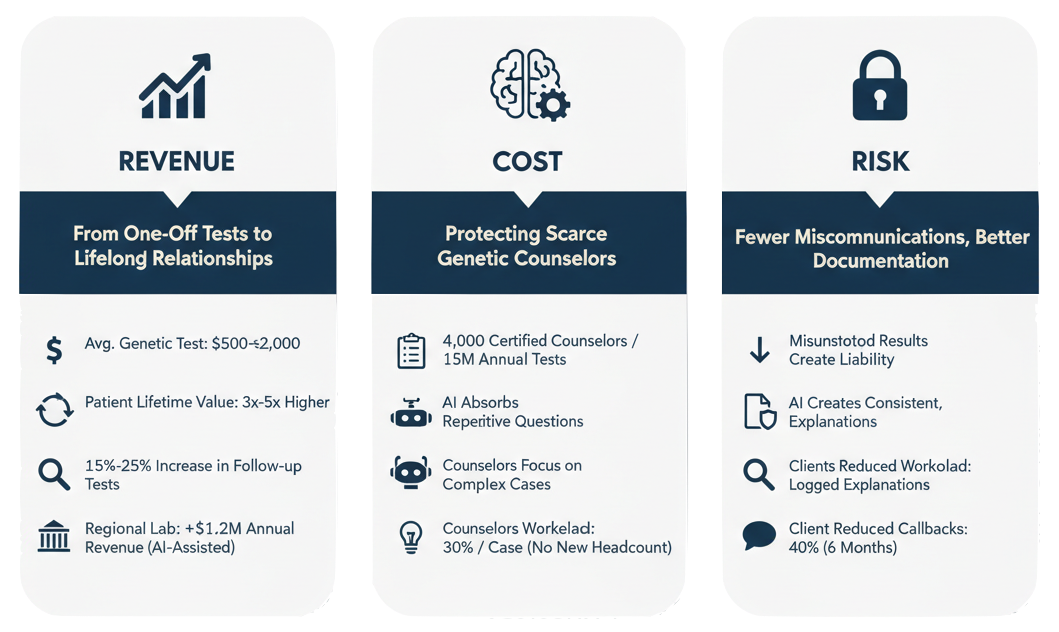
The average genetic test is a $500 to $2,000 transaction. But the lifetime value of a patient who understands their risk and comes back for cascade testing is 3x to 5x higher. Our clients see a 15% to 25% increase in follow-up test ordering when patients understand what their results mean. One regional lab chain attributed $1.2M in incremental annual revenue to their AI-assisted result communication in the first year.
That number alone should be enough to get your attention.
Cost: Protecting Scarce Genetic Counselors
There are roughly 4,000 certified genetic counselors in the US for an estimated 15 million annual genetic tests. The math doesn’t work.
AI takes the repetitive “what does this mean?” questions off the counselors’ plates so they can focus on complex cases and the emotional situations where human judgment is irreplaceable. Two of our clients cut counselor workload by 30% per case without adding headcount.
Risk: Fewer Miscommunications, Better Documentation
Misunderstood results create real liability. A patient who doesn’t understand a positive BRCA result doesn’t pursue preventive care. A lab that can’t document what the patient was told has exposure.
AI assistants create consistent, logged explanations that can be reviewed and audited. One client cut their patient callback volume by 40% in six months.
Governance: Where Most AI Initiatives Die
Not the technology. The governance.
Clear Guardrails and Escalation Policies
The board must define what the assistant handles on its own and where humans step in. We use three tiers:
- Tier 1 (AI solo): Standard results, common questions, basic definitions
- Tier 2 (AI helps, human delivers): Complex results, VUS findings, family history
- Tier 3 (human only): Acute clinical action items, psychological counseling needs
This isn’t about limiting the AI. It’s about knowing where the liability boundary lives.
AI Policy for Genomic Data
Boards are adopting explicit AI policies. Extend yours to genomic data: consent for how explanations are generated, transparency on training data, and explainability so any result can be traced. Treat it like IRB oversight for clinical trials.
Monitor Performance and Drift Over Time
Treat the assistant as a product line, not a one-time deployment. Define KPIs for accuracy, equity across patient populations, and follow-through rates. Schedule quarterly re-audits. Models drift. Your governance must be continuous.
Patient Experience and Brand Trust
Clarity and empathy in result explanations are central to trust in precision medicine. And trust is one of the hardest assets to rebuild if mishandled.
A well-governed AI assistant becomes a signature of your brand’s commitment to precision and compassion. It signals to patients that you invested in making sure they understand their health data. In a market where consumer trust in genetic testing is still fragile, this is a competitive differentiator that few of your competitors have invested in.
Our clients see a 10-point NPS improvement within nine months of deployment. The numbers back this.
Workforce: Supporting Experts, Not Replacing Them
Position the assistant as a copilot that handles initial education and FAQs, with humans handling judgment and emotional nuance. This is the language that wins clinician buy-in and avoids the political friction that kills AI initiatives in healthcare.
Involve genetic counselors early. Co-design the response scripts. Make the impact on their workload visible.
The Roadmap: 12 to 18 Months
Months 0-3: Vision and Guardrails
Define scope, desired patient experience, governance model, and success metrics. Identify one or two high-value test types for pilot.
Months 3-9: Pilot with Measurable Targets
Deploy to initial cohort. Set targets on satisfaction, counselor time saved, and follow-through rates. This phase gives you real numbers that validate or challenge your assumptions.
Months 9-18: Scale as a Strategic Capability
Integrate with portals and marketing journeys. Position result explanations as a core differentiator in your precision medicine narrative.
What to Ask Your Team Before Green-Lighting
- Is this aligned with our top three strategic priorities in genomics and patient experience?
- How will we measure success in revenue, cost, and risk terms?
- What is our governance and escalation model, and who owns it?
- How will we communicate to patients and clinicians what the assistant can and cannot do?
- Who in the C-suite is accountable for this initiative?
If they can’t answer all five, the initiative isn’t ready for board approval.
Related Reading
This piece focuses on the strategic case for C-suite ownership. If your team is evaluating specific tools and vendors, see our practical guide on how to evaluate AI assistants for genetic test results.
For a deeper dive on the technology and implementation, read why genetic testing companies need conversational AI now.
Close
We’ve deployed these principles at three genomics organizations. If you’re defining your 12 to 18 month AI genomics roadmap, we can share what works, what fails, and the numbers behind both.
Talk to us if your board is asking the same questions this piece addresses. We’ve done this before.
Curious what a deployed AI assistant for genomic reports looks like? See how our Medical AI Assistant works.
This article originally appeared on lightrains.com
Leave a comment
To make a comment, please send an e-mail using the button below. Your e-mail address won't be shared and will be deleted from our records after the comment is published. If you don't want your real name to be credited alongside your comment, please specify the name you would like to use. If you would like your name to link to a specific URL, please share that as well. Thank you.
Comment via email





![Cross-Provider AI Brand Visibility Audit [Step-by-Step]](/open-graph/blogs/cross-provider-ai-brand-visibility-audit.png)