Prompt engineering is the art and science of crafting effective prompts to guide AI models, such as OpenAI’s GPT, to generate desired outputs. Whether you’re a beginner or an intermediate user, understanding the fundamentals of prompt engineering can significantly enhance your ability to interact with AI systems. This guide covers practical techniques, example use cases, and tips to help you get the most out of your AI interactions.
For teams implementing AI at scale, our AI consulting services include prompt engineering strategy and optimization for production systems.
What is Prompt Engineering?
Prompt engineering is the practice of designing input queries (or “prompts”) to direct an AI model to produce the most accurate and useful output. Think of it as writing instructions for an AI assistant clear, detailed, and context-aware prompts yield better results. Our expert prompt engineering consultants can help you craft the perfect prompts for your AI needs. Contact us today to learn more.
Why is Prompt Engineering Important?
AI models don’t inherently understand human intentions. The way you frame your question or task greatly influences the outcome. Poorly structured prompts can lead to vague, irrelevant, or incorrect responses, while well-crafted prompts can result in precise and creative outputs.
For example:
❌ Bad:
"Tell me about AI."
✅ Good:
"Write a 200-word introduction to artificial intelligence, focusing on its applications in healthcare and education."
The second prompt provides clarity and direction, leading to a much more relevant and structured output.
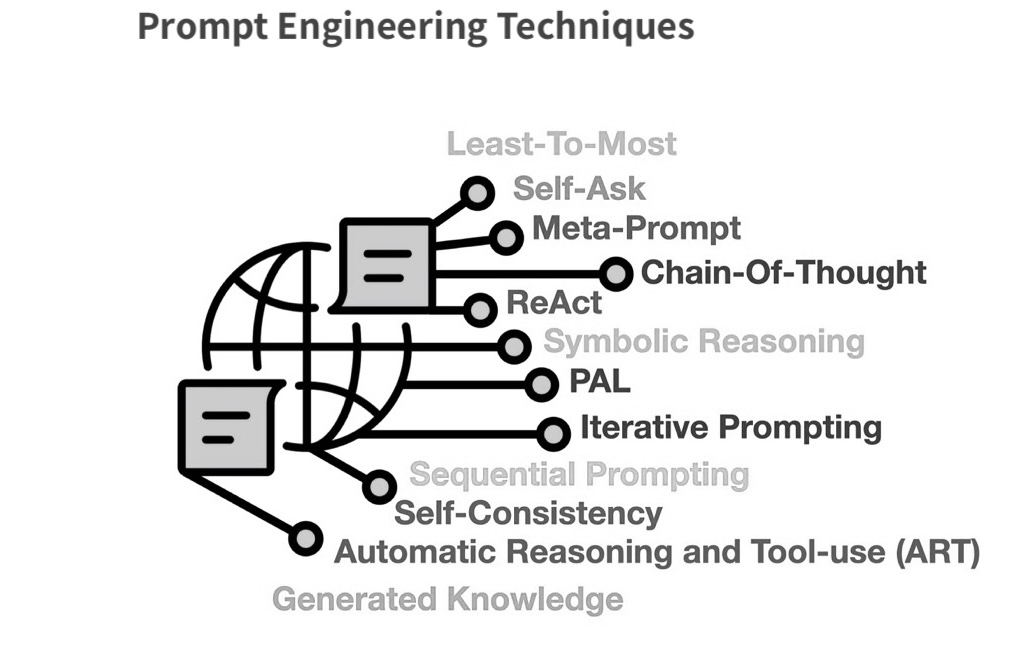
Basic Prompt Engineering Techniques
1. Be Specific
Technique: Clearly define what you want the AI to do. Avoid ambiguity and be as specific as possible.
Example: Instead of asking, “Tell me about history,” you could ask, “Provide a brief overview of the causes and consequences of the American Civil War.”
2. Use Contextual Clues
Technique: Provide context to guide the AI’s response. This can include background information, the format you want the answer in, or the perspective you want the AI to take.
Example: “As a historian, explain the significance of the Magna Carta in the development of constitutional law.”
3. Iterative Refinement
Technique: Start with a broad prompt and refine it based on the AI’s responses. This iterative process helps you zero in on the most effective prompt.
Example: Initial prompt: “Explain photosynthesis.” Refined prompt: “Explain the process of photosynthesis in plants, including the role of chlorophyll and sunlight.”
4. Use Examples
Technique: Provide examples within your prompt to guide the AI’s output. This is particularly useful for tasks requiring a specific format or style.
Example: “Write a poem in the style of Robert Frost. Example: ‘Whose woods these are I think I know…‘“
5. Leverage Role-Playing
Technique: Ask the AI to assume a specific role or persona to tailor its responses.
Example: “As a career counselor, provide advice on how to prepare for a job interview in the tech industry.”
6. Break Down Complex Tasks
Technique: Divide complex tasks into smaller, more manageable sub-tasks. This can help the AI provide more focused and accurate responses.
Example: Instead of asking, “Write a research paper on climate change,” break it down: “First, outline the main causes of climate change. Next, discuss its impact on polar ice caps.”
7. Use Constraints
Technique: Apply constraints to narrow down the AI’s focus. This can include word limits, specific formats, or particular angles.
Example: “Summarize the plot of ‘1984’ by George Orwell in 100 words or less.”
8. Ask for Step-by-Step Explanations
Technique: Request detailed, step-by-step explanations to ensure thoroughness and clarity.
Example: “Explain how to solve a quadratic equation, step by step.”
Enterprise Use Cases for Prompt Engineering
Beyond individual use, prompt engineering powers critical business applications:
- Customer Support Automation: Structured prompts enable AI chatbots to handle tier-1 support queries with consistent tone and accuracy.
- Content Generation at Scale: Marketing teams use prompts to generate product descriptions, email drafts, and social media copy.
- Code Assistance: Development teams integrate prompt-engineered AI for code review, documentation, and bug explanation.
- Data Extraction: Prompts guide AI to parse unstructured documents into structured formats.
For advanced techniques, see our guide on DeepSeek AI prompting techniques for developer-specific patterns.
Tips for Effective Prompt Engineering
-
Experiment and Iterate: Don’t be afraid to experiment with different prompts and refine them based on the AI’s responses.
-
Understand the Model’s Limitations: Be aware of the AI’s strengths and weaknesses. Some tasks may require more nuanced or specialized models.
For deeper learning, our beginner’s guide to LLMs and top LLM FAQs provide additional context on how prompt engineering fits into the broader AI landscape.
-
Use Feedback Loops: Continuously provide feedback to the AI to improve its responses over time.
-
Stay Updated: AI models are constantly evolving. Stay informed about updates and new features that can enhance your prompt engineering efforts.
Prompt engineering is both an art and a science. By mastering the techniques outlined above, you can unlock the full potential of AI tools for a variety of tasks whether you’re creating content, solving problems, or automating workflows. Start small, experiment boldly, and refine your skills to harness the power of AI in your personal and professional life.
Some good reads:
Need help implementing prompt engineering in your organization? Lightrains provides prompt engineering services that cover prompt design, evaluation, and optimization for production AI systems. Contact our team to discuss your requirements.
This article originally appeared on lightrains.com
Leave a comment
To make a comment, please send an e-mail using the button below. Your e-mail address won't be shared and will be deleted from our records after the comment is published. If you don't want your real name to be credited alongside your comment, please specify the name you would like to use. If you would like your name to link to a specific URL, please share that as well. Thank you.
Comment via email




![Cross-Provider AI Brand Visibility Audit [Step-by-Step]](/open-graph/blogs/cross-provider-ai-brand-visibility-audit.png)